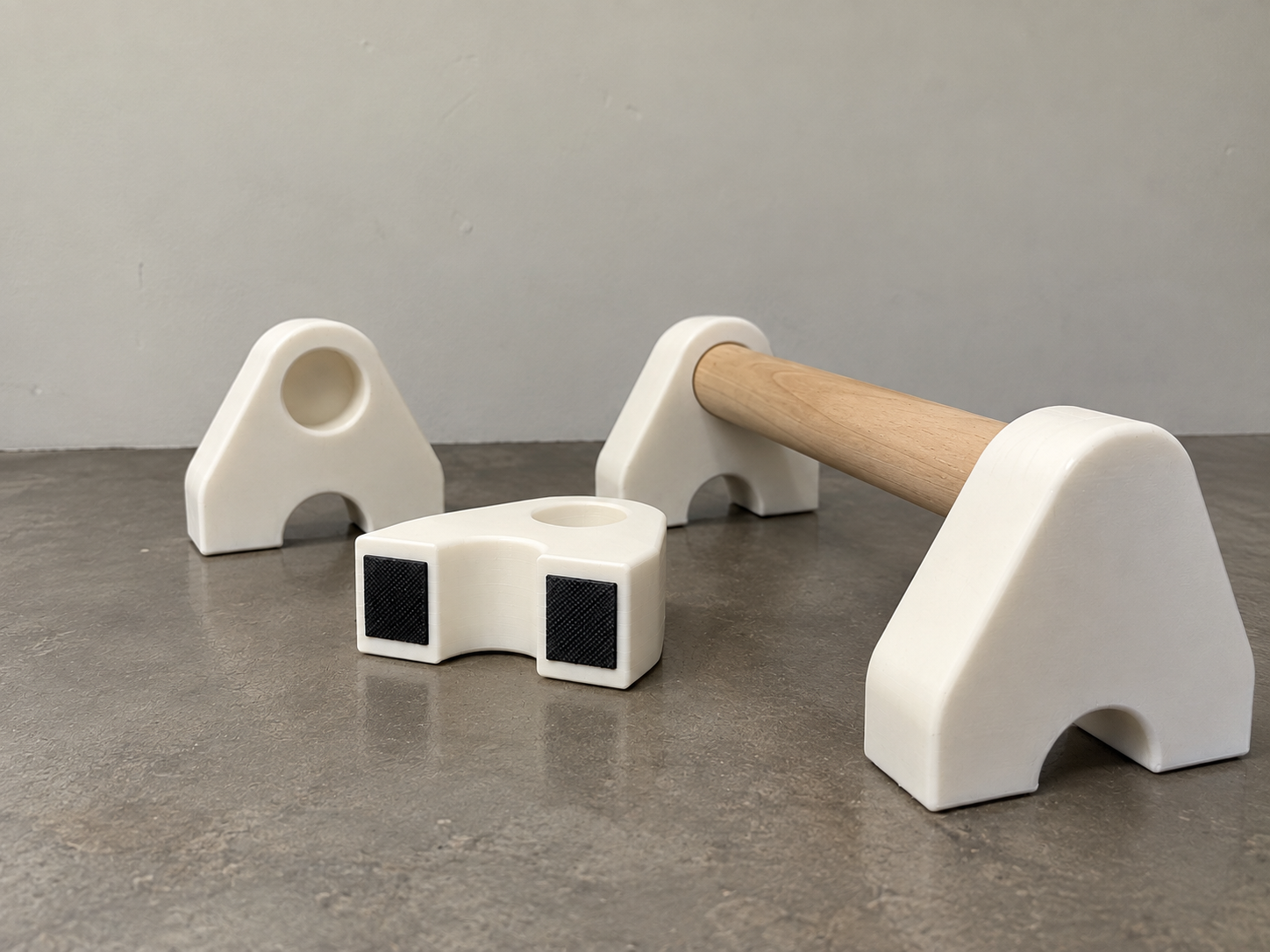
This project began as a way to design a practical piece of gym equipment that I would actually use. I created a compact parallette for calisthenics training and now use it four days a week.
The project is also a good example of how strong and capable 3D-printed parts can be when the geometry and load path are designed properly.
Design Intent
Simple geometry with a clear structural load path.
The parallette uses a cylindrical handle supported by two printed side legs. The geometry keeps the design stable, easy to grip, and straightforward to manufacture while still directing the highest loads through predictable structural regions.
I focused on creating a design that looked clean, felt solid in use, and could demonstrate the real-world potential of printed fitness equipment.
Design Optimization
Half the material without sacrificing the load target.
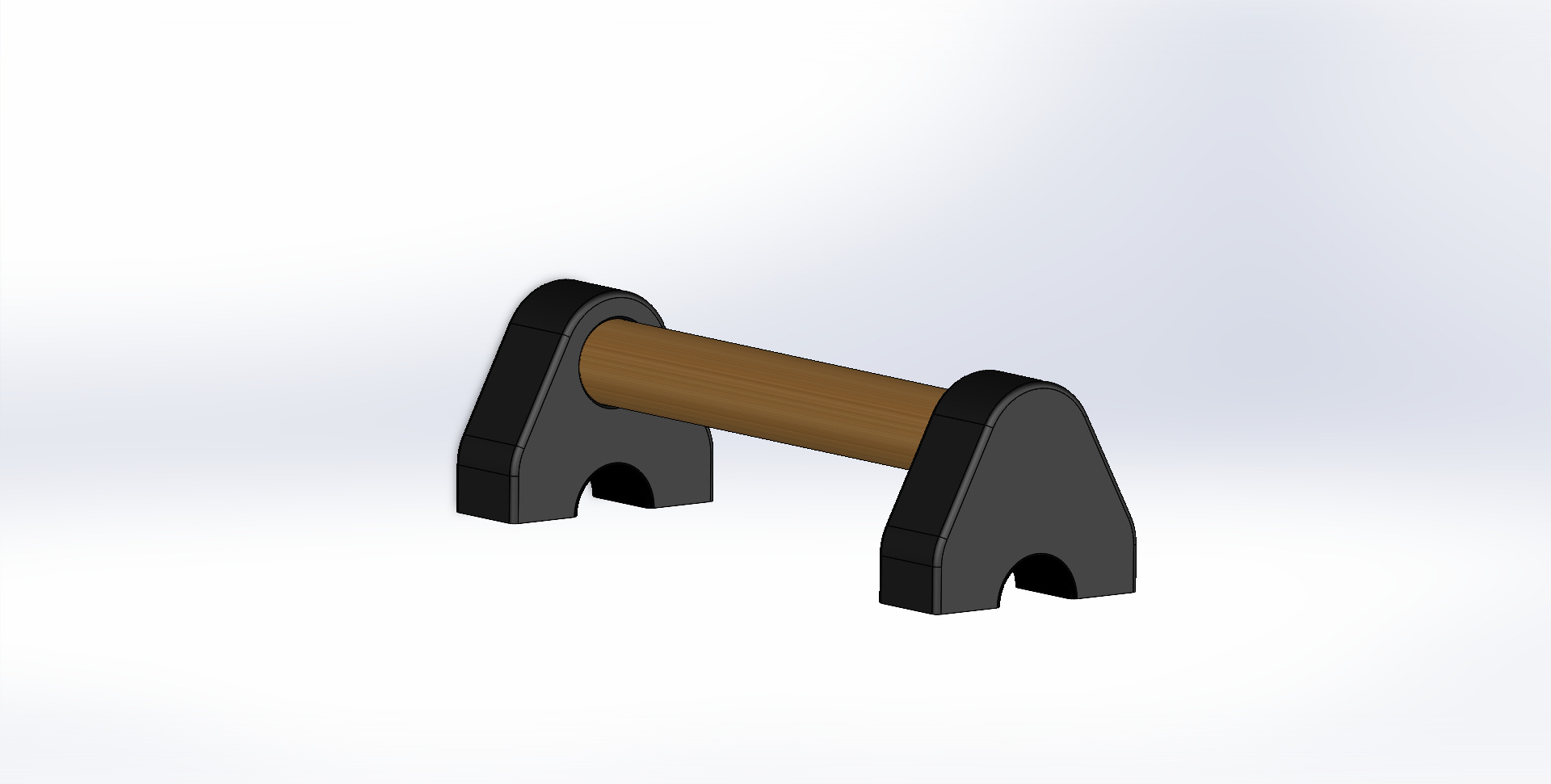
I redesigned the side supports with material-saving cutouts to make the product faster and cheaper to manufacture. The lighter version reduced filament use and print time by approximately 50 percent while maintaining the same intended load target.
The smaller footprint also allowed twice as many support parts to fit on a single printer bed. That matters because 3D-printing cost is not just material cost. It is also machine time, bed capacity, and how many parts can be produced in each print cycle.
A cost breakdown for the final short-handle design puts manufacturing at $8.47 per set. At a $28 list price with a 15 percent promo and $9 shipping, each order collects $32.80. After scrap, printer wear, packing, shipping, and payment fees, that leaves about $12.00 of profit per set, a 50 percent margin on the sale price.
Click to enlarge
Final CAD design with arched, material-saving cutouts in the side supports.
Manufacturing / set$8.47
Total cost / order$20.80
Net profit / set$12.00
Margin on sale50%
Cost per set · short-handle design
Component
Basis
Cost
Wood dowel
2 per set
$3.33
Rubber stoppers
8 per set
$1.11
3D-printed blocks
4 per set
$4.03
Manufacturing cost
Per set
$8.47
Failed prints / scrap
8%
$0.32
Printer wear / electricity
Per set
$0.50
Packing
Per order
$1.25
Additional costs
Per set
$2.07
Per-order economics · one set
Line item
Basis
Amount
List price
$28.00
Promo discount
15%
−$4.20
Shipping charged
$9.00
Total collected
Sale price $23.80 + shipping
$32.80
Payment fees (Stripe)
2.9% + $0.30
−$1.25
Manufacturing cost
Per set
−$8.47
Shipping cost
Per order
−$9.00
Additional costs
Per set
−$2.07
Net profit
Per set
$12.00
Margin on sale price
$12.00 ÷ $23.80
50%
Margin on total collected
$12.00 ÷ $32.80
36.6%
Finite Element Analysis
Validating the design with ANSYS.
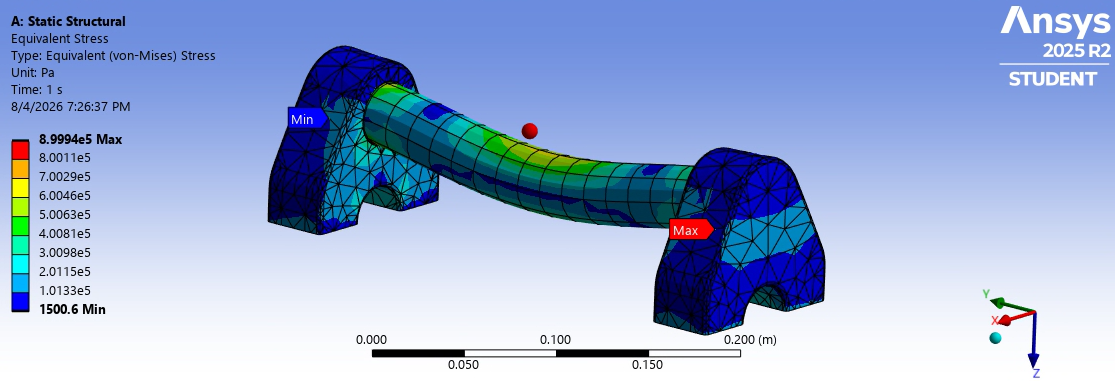
To evaluate the structural integrity of the parallette, I performed a static finite element analysis in ANSYS Mechanical. A 228 N downward load was applied to the handle, representing the approximate force exerted by one arm during a standard push-up by a 160 lb user. The feet were constrained to simulate contact with the ground.
The analysis produced a maximum von Mises stress of 0.90 MPa, concentrated near the handle-to-leg transition where the highest bending stresses occur. This stress is significantly below the yield strength of common 3D-printing materials, indicating that the design can safely withstand the expected loading conditions with a substantial factor of safety.
The simulation also confirmed that the highest stresses occur in the anticipated critical region, validating the overall geometry and load path of the design.
Scaling the same load case from a 160 lb user to a 200 lb user increases the predicted stress from 0.90 MPa to approximately 1.13 MPa, which remains very low relative to typical printed-plastic strength values. This supports use by a 200 lb person under the same assumptions. The simulation was not a destructive certification test, so I do not present it as a verified maximum weight rating.
Click to enlarge
ANSYS Mechanical equivalent von Mises stress result for the 228 N representative one-arm push-up load case.
Outcome
Validated in analysis and in training.
Beyond simulation, the project has also been validated through repeated real-world use in calisthenics training. Using the equipment regularly helped confirm that the design performs as intended and reinforced the broader point that 3D-printed parts can be far stronger and more useful than many people expect.
This project strengthened my skills in product design, structural thinking, and simulation-based validation while showing how engineering analysis can support practical prototyping decisions.
What this study showed meAdditive manufacturing can produce genuinely useful structural products when the geometry, load path, print strategy, and material use are treated as engineering decisions rather than just printing decisions.